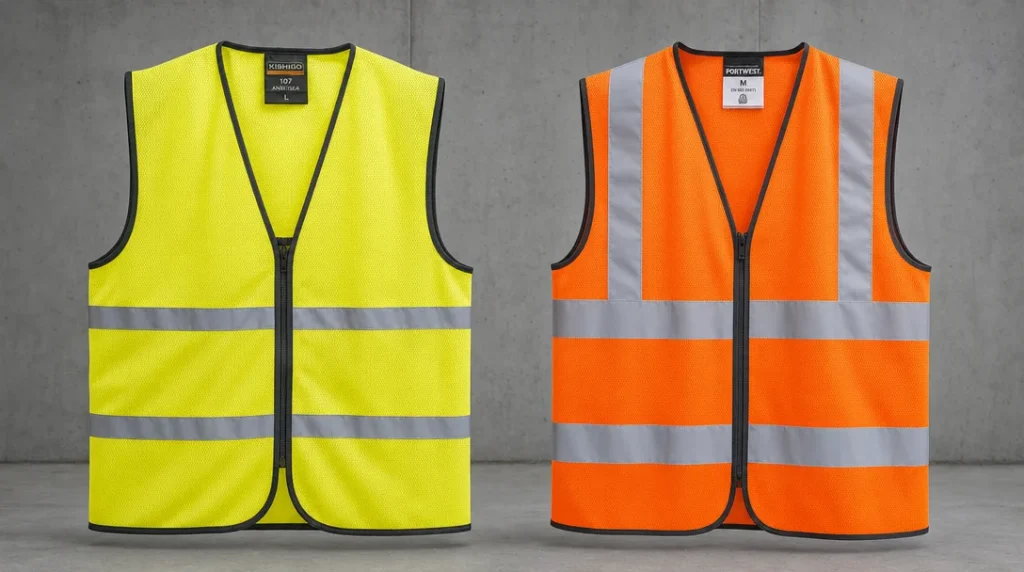
ANSI 대 EN ISO 고휘도 표준: 완벽 가이드
ANSI/ISEA 107 대 EN ISO 20471: 완벽한 글로벌 고휘도 표준 비교 가이드
독일의 구매 관리자가 도로 건설 프로젝트를 위해 안전 조끼 5,000벌을 주문하고, 텍사스의 안전 책임자가 고속도로 유지보수 팀을 위해 동일한 수량을 필요로 할 때, 그들은 같은 의류를 주문하는 것이 아닙니다. 독일 구매자는 특정 최소 가시 영역과 유럽 요구 사항을 충족하는 광도 측정 테스트를 갖춘 EN ISO 20471 준수를 기대합니다. 미국 구매자는 미국 표준 기관이 정의한 등급 평가와 색상 사양을 갖춘 ANSI/ISEA 107 준수를 기대합니다. 이 두 체계의 차이를 이해하는 것은 국제 시장에서 고휘도 안전 의류를 조달, 판매 또는 사용하는 기업에게 선택 사항이 아닙니다.
이 가이드는 ANSI/ISEA 107과 EN ISO 20471의 상세한 비교를 제공합니다. 등급 체계, 재료 요구 사항, 테스트 절차, 색상 사양, 그리고 하나 또는 두 표준을 모두 충족하는 의류를 조달해야 하는 기업을 위한 실용적인 지침을 다룹니다. 도매업자, 안전 준수 담당자 또는 제조업자이든, 아래 정보는 고휘도 안전 의류 조달에 관한 정보에 기반한 결정을 내리는 데 도움이 될 것입니다.
관련 항목: ANSI 등급 평가 이해
고휘도 구매자에게 글로벌 표준이 중요한 이유
고휘도 안전 의류는 한 가지 명확한 목적을 위해 존재합니다: 저조도 조건과 복잡한 시각 환경에서 작업자를 눈에 띄게 만드는 것입니다. 작업자가 이동 차량, 중장비 또는 저조도 조건 근처에 있을 때, 보이는 것과 보이지 않는 것의 차이는 미터와 초 단위로 측정될 수 있습니다. 표준은 이 작업자들이 착용하는 의류가 안전이 의존하는 가시 성능을 실제로 제공하도록 보장하기 위해 존재합니다.
특정 표준에 대한 언급 없이 "고휘도"로 표시된 의류는 측정 가능한 성능이 없다는 점을 이해하는 것이 중요합니다. 이 용어만으로는 반사 재료가 얼마나 있는지, 배경 직물의 색상이 무엇이어야 하는지, 의류가 어떻게 테스트되었는지, 또는 재료가 반복 세탁과 햇빛 노출 후에도 성능을 유지할 것인지 알 수 없습니다.
글로벌 무역으로 인해 단일 기업이 한 지역의 제조업체로부터 안전 의류를 조달하고, 다른 지역에서 유통하며, 또 다른 규정 세트를 준수해야 하는 작업자를 배치하는 것이 일반적이 되었습니다. 유럽 유통을 위해 중국에서 제조된 의류는 EN ISO 20471 요구 사항을 충족해야 합니다. 동일한 의류가 미국으로 배송되는 경우 OSHA 기대를 충족하려면 ANSI/ISEA 107 요구 사항을 충족해야 합니다. 두 시장 모두에 판매하는 기업은 두 표준과 그 차이를 이해해야 합니다.
재정적 영향은 상당합니다. 특정 시장에 맞지 않는 표준을 충족하는 의류를 주문하면 재고 낭비, 준수 감사 실패, 사고 발생 시 잠재적 책임이 발생합니다. 이것이 고휘도 표준 비교가 국경을 넘어 운영하거나 국제 고객에게 서비스를 제공하는 모든 기업에게 중요한 이유입니다.
관련 항목: ANSI 준수 작업복으로 더 안전한 작업장 만들기
ANSI/ISEA 107이란?
역사와 목적
ANSI/ISEA 107은 고휘도 안전 의류 및 액세서리에 대한 미국 국가 표준입니다(ISEA.org에서 표준 보기). 1999년 국제 안전 장비 협회(ISEA)에 의해 처음 발행되었으며 미국 국가 표준 협회(ANSI)의 승인을 받았습니다. 이 표준은 교통 구역, 건설 현장 및 작업자가 이동 차량 및 장비와 공간을 공유하는 산업 환경에서 작업자 가시성에 대한 우려가 커지면서 개발되었습니다.
이 표준은 원래 발행 이후 여러 번 개정되었습니다. 현재 버전인 ANSI/ISEA 107-2020은 등급 정의, 재료 테스트 요구 사항 및 의류 설계 사양에 대한 업데이트를 포함합니다. 이러한 개정은 작업장 조건의 변화, 재료 기술의 발전 및 작업장 사고 조사에서 얻은 교훈을 반영합니다.
ANSI/ISEA 107의 목적은 고휘도 안전 의류에 대한 최소 성능 기준을 설정하는 것입니다. 이 표준은 반사 재료 및 배경 재료의 양과 배치를 정의하고, 허용 가능한 색상을 지정하며, 광도 성능 임계값을 설정하고, 세탁 및 풍화 노출 후 색상 견뢰도, 치수 안정성 및 반사 성능에 대한 테스트 방법을 확립합니다.
세 가지 등급 설명
ANSI/ISEA 107은 고휘도 안전 의류의 세 가지 등급을 정의합니다. 분류는 의류에 필요한 최소 가시 재료 면적과 의도된 사용 환경을 기반으로 합니다:
클래스 1 — 최저 가시성 수준
-
최소 면적: 배경 및 반사 재료 결합 217제곱인치(1,400제곱센티미터)
-
교통 속도: ≤ 시속 25마일
-
사용 사례: 주차장 안내원, 창고 작업자, 보도 유지보수 인원
-
주요 조건: 작업자가 장벽으로 교통과 분리되어 있거나, 접근하는 교통에 완전히 주의를 기울일 수 있는 경우
클래스 2 — 가시성 향상
-
최소 면적: 배경 및 재귀반사 소재 합계 775제곱인치(5,000제곱센티미터)
-
교통 속도: > 시속 25마일
-
사용 사례: 도로 공사 작업자, 공항 지상 요원, 학교 횡단 보도 관리자, 유틸리티 작업자
-
주요 조건: 기상 조건으로 가시성이 저하되거나 작업자가 교통량에 더 가까이 위치하는 경우
클래스 3 — 최고 가시성 등급
-
최소 면적: 배경 및 재귀반사 소재 합계 1,240제곱인치(8,000제곱센티미터)
-
교통 속도: > 시속 50마일
-
사용 사례: 고속도로 건설 작업반, 응급 구조대원, 활주로에서 작업하는 측량사
-
주요 조건: 가시성 조건이 열악하거나 작업자가 더 먼 거리 및 모든 각도에서 보여야 하는 경우
-
필수 적용 범위: 몸통과 팔 또는 다리 모두에 재귀반사 소재
관련 항목: 클래스 3 고가시성: 최대 작업장 안전을 위한 가이드
EN ISO 20471이란?
역사와 목적
EN ISO 20471은 고가시성 안전 의류에 대한 유럽 표준(ISO.org에서 보기)입니다. 2013년에 이전 EN 471 표준을 대체하는 조화 유럽 표준으로 발표되었습니다. 이 표준은 유럽 시장 전반에 걸쳐 고가시성 의류에 대한 통합 사양을 만들기 위해 유럽 표준화 위원회(CEN)와 국제 표준화 기구(ISO)가 공동으로 개발했습니다.
EN 471에서 EN ISO 20471로의 전환은 몇 가지 중요한 변경 사항을 도입했습니다. 새로운 표준은 광도 요구 사항을 업데이트하고, 최소 면적 계산을 수정하고, 추가 의류 유형을 포함하도록 범위를 확장하고, 테스트 절차를 현재 ISO 방법론과 일치시켰습니다. 이 표준은 ISO 기술 위원회 시스템을 통해 유지 관리되며 재료 과학 및 작업장 안전 연구의 발전을 반영하기 위해 주기적으로 검토됩니다.
EN ISO 20471의 목적은 위험한 조건에서 착용자의 존재를 시각적으로 신호할 수 있는 고가시성 의류에 대한 요구 사항을 지정하는 것입니다. 이 표준은 배경 소재의 색도 및 휘도 특성, 복합 성능 소재의 재귀반사 특성, 각 등급에 필요한 최소 소재 면적, 반사 요소의 설계 및 배치 요구 사항을 다룹니다.
세 가지 등급 설명
EN ISO 20471도 세 가지 등급을 정의하지만 최소 면적 요구 사항은 ANSI/ISEA 107과 다릅니다. 두 표준 모두 세 등급 시스템을 사용하지만 숫자 값과 면적 계산 방식이 직접적으로 동등하지 않다는 점에 유의해야 합니다:
클래스 1 — 기본 가시성
-
형광 소재: 최소 0.14제곱미터(1,400제곱센티미터)
-
재귀반사 소재: 최소 0.10제곱미터(1,000제곱센티미터)
-
사용 사례: 저속 교통 환경, 이동 차량에 근접하지 않은 작업자
-
의류 유형: 제한된 반사 줄무늬가 있는 안전 조끼 및 티셔츠
클래스 2 — 향상된 가시성
-
형광 소재: 최소 0.50제곱미터(5,000제곱센티미터)
-
재귀반사 소재: 최소 0.13제곱미터(1,300제곱센티미터)
-
사용 사례: 중간 속도 교통 도로, 철도 승강장, 공항 에이프런
-
의류 유형: 더 넓은 반사 밴딩이 있는 전신 조끼 및 재킷
클래스 3 — 최대 가시성
-
형광 소재: 최소 0.80제곱미터(8,000제곱센티미터)
-
재귀반사 소재: 최소 0.20㎡(2,000㎠)
-
사용 사례: 고속도로 공사, 비상 대응, 모든 각도에서의 장거리 시인성
-
필수 적용 범위: 몸통과 팔을 모두 덮어야 하며, 전신 재킷 및 작업복 포함 가능
나란히 비교: 등급 요건 및 최소 면적
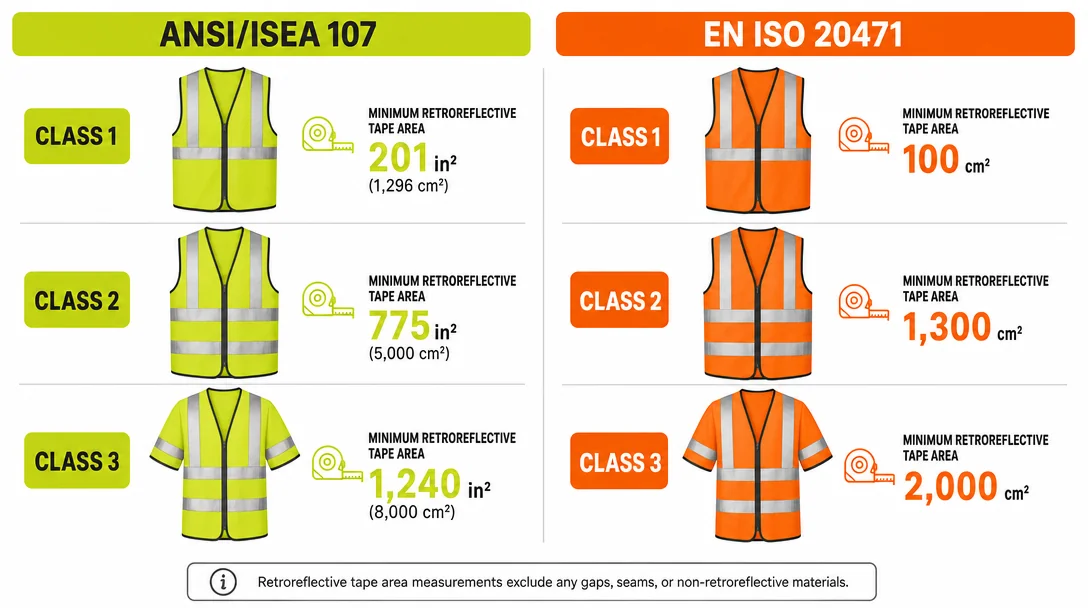
ANSI/ISEA 107과 EN ISO 20471을 비교하는 가장 실용적인 방법은 각 등급별 최소 재료 요건을 검토하는 것입니다. 아래 표는 직접 비교가 가능한 형식으로 요건을 제시합니다. 두 표준 간 단위가 다르므로 환산값을 함께 제공합니다.
| 표준 | 클래스 | 최소 합산 면적 | 최소 배경/형광 면적 | 최소 재귀반사 면적 |
|---|---|---|---|---|
| ANSI/ISEA 107 | 클래스 1 | 217 sq in (1,400㎠) | 별도로 규정되지 않음 | 별도로 규정되지 않음 |
| ANSI/ISEA 107 | 클래스 2 | 775 sq in (5,000㎠) | 별도로 규정되지 않음 | 별도로 규정되지 않음 |
| ANSI/ISEA 107 | 클래스 3 | 1,240 sq in (8,000㎠) | 별도로 규정되지 않음 | 별도로 규정되지 않음 |
| EN ISO 20471 | 클래스 1 | 해당 없음 | 0.14㎡ (1,400㎠) | 0.10㎡ (1,000㎠) |
| EN ISO 20471 | 클래스 2 | 해당 없음 | 0.50㎡ (5,000㎠) | 0.13㎡ (1,300㎠) |
| EN ISO 20471 | 클래스 3 | 해당 없음 | 0.80㎡ (8,000㎠) | 0.20㎡ (2,000㎠) |
색상 사양 비교
두 표준 모두 동일한 세 가지 형광 색상을 승인하지만 색도 경계는 서로 다릅니다:
| 색상 | ANSI/ISEA 107 최소 휘도 | EN ISO 20471 최소 휘도 | 주요 차이점 |
|---|---|---|---|
| 형광 노랑/옐로 그린 | 0.45 | 0.45 | 색도 경계가 약간 다르므로 한쪽에서 허용되는 색상이 다른 쪽에서는 부적합할 수 있음 |
| 형광 오렌지 레드 | 0.15 | 0.15 | CIE 색공간에서 경계 좌표가 다름 |
| 형광 레드 | 0.07 | 0.07 | 측정 형상 및 광원 조건은 표준 간에 다릅니다. |
제조사를 위한 중요 참고사항: ANSI/ISEA 107에서 허용 범위에 속하는 색상이 EN ISO 20471에서는 허용 범위를 벗어날 수 있습니다. 배경 원단은 각 해당 표준에 따라 별도로 시험 및 인증되어야 합니다.
배경 재료 요구사항
ANSI/ISEA 107은 배경 및 재귀반사 재료의 조합에 대한 최소 면적을 규정하지만, 각 등급에 대해 배경 재료의 최소 면적을 별도로 강제하지는 않습니다. 대신, 이 표준은 색도 및 휘도 계수 측면에서 배경 재료에 대한 성능 요구사항을 정의합니다. 배경 재료는 승인된 형광 색상 중 하나여야 하며, 지정된 광도 임계값을 충족해야 합니다.
EN ISO 20471은 각 등급에 대해 형광(배경) 재료와 재귀반사 재료에 대한 별도의 최소 면적을 규정하는 다른 접근 방식을 취합니다. 즉, EN ISO 20471에서는 제조사가 형광 면적과 재귀반사 면적이 독립적으로 최소 임계값을 충족하도록 보장해야 합니다. 의복은 더 많은 재귀반사 테이프를 추가하여 불충분한 형광 재료를 보상할 수 없으며, 그 반대도 마찬가지입니다.
이러한 차이는 의복 설계에 실질적인 영향을 미칩니다. ANSI/ISEA 107 클래스 2 요구사항을 충족하도록 설계된 조끼는 EN ISO 20471 클래스 2 요구사항을 충족하도록 설계된 조끼와 배경 원단 대 반사 테이프의 비율이 다를 수 있습니다. 구매 전문가는 의복이 해당 시장에 적용되는 표준의 특정 요구사항을 충족하는지 확인해야 합니다.
재귀반사 재료 요구사항
재귀반사 재료 요구사항도 두 표준 간에 다릅니다. ANSI/ISEA 107에 따르면, 재귀반사 재료는 지정된 관찰 각도 및 입사 각도에서 최소 재귀반사 계수(RA) 값을 충족해야 합니다. 이 표준은 재귀반사 재료가 지정된 컨디셔닝 절차에 노출된 후 관찰 각도 0.2도 및 입사 각도 -4.0도에서 최소 RA 값 100 cd/lx/m²를 유지해야 한다고 규정합니다.
EN ISO 20471은 재료가 재귀반사 재료로 분류되는지 또는 복합 성능 재료로 분류되는지에 따라 달라지는 최소 RA 값을 규정합니다. 재귀반사 재료의 경우, 관찰 각도 0.2도 및 입사 각도 5.0도에서 최소 RA 값은 330 cd/lx/m²입니다. 배경 및 재귀반사 재료의 역할을 모두 하는 복합 성능 재료의 경우, 요구사항이 다르며 형광 및 재귀반사 성능 기준을 모두 포함합니다.
시험 각도와 최소 값의 차이는 한 표준에 따라 인증된 재귀반사 재료가 다른 표준에 따라 자동으로 적합하지 않을 수 있음을 의미합니다. 이중 시장 유통을 위한 의복을 생산하는 제조사는 두 표준 모두에 따라 시험 및 인증된 재료를 조달해야 합니다.
관련 항목: 반사 안전 재킷의 진화
재귀반사 테이프 배치 규칙
ANSI 배치 패턴
ANSI/ISEA 107은 의복에 재귀반사 재료의 배치 및 구성에 대한 요구사항을 규정합니다. 이 표준은 의복 등급에 따라 재귀반사 재료가 몸통, 팔 또는 다리를 둘러싸도록 배치되어야 한다고 요구합니다. 클래스 1 및 클래스 2 의복의 경우 재귀반사 재료가 몸통을 둘러싸야 합니다. 클래스 3 의복의 경우 재귀반사 재료가 몸통과 최소 한 쌍의 팔다리를 모두 둘러싸야 합니다.
이 표준은 재귀반사 밴드의 최소 너비를 규정합니다. ANSI/ISEA 107에 따라 분류된 의복의 경우, 재귀반사 밴드는 몸통에 배치될 때 최소 1인치(25mm) 너비여야 하며, 팔다리에 배치될 때도 최소 1인치(25mm) 너비여야 합니다. 이 표준은 또한 분할형 재귀반사 패턴을 허용하는데, 재귀반사 재료의 총 면적이 최소 요구사항을 충족하고 분할 사이의 간격이 지정된 한도를 초과하지 않는 경우에 한합니다.
ANSI 준수 의복에 재귀반사 재료를 배치하는 것은 인식 가능한 인간 실루엣을 만드는 것을 목표로 합니다. 몸통을 둘러싸는 밴드는 신체 윤곽을 정의하고, 팔과 다리의 밴드는 팔다리 움직임을 정의합니다. 이 구성은 관찰자가 착용자를 정적인 물체가 아닌 사람으로 식별하는 데 도움을 주며, 이는 특히 거리와 저조도 조건에서 중요합니다.
EN ISO 배치 패턴
EN ISO 20471도 재귀반사 재료의 배치 요구사항을 규정하지만, 패턴과 구성은 ANSI/ISEA 107과 다릅니다. EN ISO 20471에 따르면 재귀반사 재료는 의복의 명확한 윤곽을 만들고 여러 각도에서 착용자의 가시성을 최대화하도록 배치되어야 합니다. 이 표준은 클래스 2 및 클래스 3 의복의 경우 최소 두 개의 재귀반사 밴드가 몸통을 둘러싸고, 클래스 3 의복의 경우 추가 밴드가 팔을 둘러싸야 한다고 요구합니다.
EN ISO 20471에 따른 재귀반사 밴드의 최소 너비는 50mm(약 2인치)입니다. 이는 ANSI/ISEA 107에서 규정한 최소 너비보다 넓으며, 이는 EN ISO 20471 요구사항을 충족하도록 설계된 의복이 ANSI 준수만을 위해 설계된 의복보다 일반적으로 더 두드러지는 반사 밴딩을 갖는다는 것을 의미합니다. 더 넓은 밴드는 의복의 시각적 외관과 재귀반사 빛이 관찰자에게 반사되는 방식에도 영향을 미칩니다.
EN ISO 20471은 몸통 주위의 수평 밴드, 어깨 위의 수직 밴드, 팔의 둘러싸는 밴드를 포함한 특정 재귀반사 배치 패턴을 허용합니다. 이 표준은 최소 밴드 수, 위치 및 밴드 간 최소 간격을 지정하는 디자인 템플릿을 제공합니다. 이러한 템플릿은 다양한 의복 디자인과 제조사 간에 일관된 가시성 성능을 보장하기 위한 것입니다.
주요 차이점
ANSI/ISEA 107과 EN ISO 20471 간의 배치 규칙의 주요 차이점은 의복 제조사와 구매자에게 실질적인 결과를 초래합니다. EN ISO 20471은 더 넓은 재귀반사 밴드를 요구하며(최소 50mm 대 ANSI의 최소 25mm), 이는 EN ISO 준수 의복이 일반적으로 더 두드러지는 반사 재료를 표시한다는 것을 의미합니다. 이는 의복의 미적 외관에 영향을 미칠 수 있으며 특정 시장에서 작업자 수용도에 영향을 줄 수 있습니다.
둘러싸는 밴드의 수와 구성도 다릅니다. EN ISO 20471은 일반적으로 클래스 2 및 클래스 3 의복에 대해 몸통에 두 개의 둘러싸는 밴드를 요구하는 반면, ANSI/ISEA 107은 총 재귀반사 면적 요구사항이 충족되면 하나의 둘러싸는 밴드로 충족될 수 있습니다. 클래스 3 의복의 팔 배치 요구사항은 두 표준에서 유사하지만, 특정 밴드 너비와 간격 요구사항은 다릅니다.
이중 시장 유통을 위한 의복을 조달하는 구매자의 경우, 이러한 차이는 한 표준의 배치 요구사항을 충족하도록 설계된 의복이 다른 표준의 배치 요구사항을 자동으로 충족하지 못할 수 있음을 의미합니다. 제조사는 두 표준을 염두에 두고 의복을 설계해야 하며 최종 제품이 모든 해당 배치, 너비 및 간격 요구사항을 충족하는지 확인해야 합니다.
색상 사양 및 광도 성능
각 표준의 승인된 색상
ANSI/ISEA 107과 EN ISO 20471 모두 배경 및 형광 재료에 대해 승인된 색상을 규정합니다. 승인된 색상은 주간 및 박명 조건에서 일반적인 배경 환경과 높은 대비를 제공하는 능력을 기준으로 선택됩니다.
ANSI/ISEA 107에 따르면, 승인된 형광 색상은 형광 황록색, 형광 주황-빨강 및 형광 빨강입니다. 이러한 색상은 CIE 색 공간 내의 특정 색도 좌표로 정의되며, 표준은 각 승인된 색상에 대해 허용 가능한 색상 범위를 정의하는 경계 좌표를 제공합니다. 색도 요구사항은 세탁 및 풍화를 시뮬레이션하는 컨디셔닝 절차에 노출된 후에도 색상이 지정된 범위 내에 유지되도록 보장합니다.
EN ISO 20471은 동일한 세 가지 형광 색상(형광 노랑, 형광 주황-빨강, 형광 빨강)을 승인합니다. 그러나 EN ISO 20471에서 정의한 색도 경계는 ANSI/ISEA 107에서 정의한 것과 약간 다릅니다. 경계 좌표의 차이는 한 표준에서 허용 범위에 속하는 색상이 다른 표준에서는 허용 범위를 벗어날 수 있음을 의미합니다. 이는 두 시장을 위해 의복을 생산하는 제조사에게 중요한 고려사항이며, 배경 원단은 각 해당 표준에 따라 시험 및 인증되어야 합니다.
Chromaticity and Luminance Factor
Chromaticity defines the hue and saturation of a color, while the luminance factor defines the brightness or lightness of the color. Both standards specify minimum luminance factor values for fluorescent background materials to ensure that the colors are sufficiently bright to provide high contrast in daylight conditions.
ANSI/ISEA 107 specifies minimum luminance factor values that vary depending on the approved color. For fluorescent yellow-green, the minimum luminance factor is 0.45. For fluorescent orange-red, the minimum is 0.15. For fluorescent red, the minimum is 0.07. These values are measured using standardized test methods specified in the standard.
EN ISO 20471 specifies minimum luminance factor values of 0.45 for fluorescent yellow, 0.15 for fluorescent orange-red, and 0.07 for fluorescent red. While the numerical values are similar to those in ANSI/ISEA 107, the measurement methods and test conditions differ. EN ISO 20471 requires testing under specific illuminant conditions and specifies the geometry for color measurement. The differences in test methodology mean that luminance factor values obtained under one standard cannot be directly compared with values obtained under the other without accounting for the methodological differences.
Performance Testing Methods
Both standards include performance testing requirements to verify that materials maintain their visibility characteristics after exposure to conditions that simulate use and maintenance. The tests are designed to ensure that garments remain compliant throughout their service life, not just when new.
ANSI/ISEA 107 requires testing for colorfastness to laundering, colorfastness to crocking (rubbing), dimensional stability, and retroreflective performance after exposure to laundering and weathering. The standard specifies the number of laundering cycles, the type of detergent, the water temperature, and the drying conditions. Materials must meet the chromaticity and luminance factor requirements after completing the specified number of test cycles.
EN ISO 20471 includes similar testing requirements but specifies different test methods and acceptance criteria. The standard requires testing in accordance with specified ISO test methods for colorfastness to washing, colorfastness to rubbing, dimensional change after washing and drying, and retroreflective performance after conditioning. The conditioning procedures under EN ISO 20471 include exposure to UV radiation, temperature cycling, and mechanical abrasion in addition to laundering.
The difference in testing methods means that a garment that passes all tests under one standard may not pass all tests under the other. Manufacturers must conduct testing under both standards when producing garments for dual-market distribution, and buyers should request test reports that demonstrate compliance with the applicable standard.
관련 항목: 기업을 위한 안전 조끼 요구 사항 및 OSHA 표준
Certification and Testing Procedures Compared
Testing and Certification Process Comparison
The testing and certification pathways differ significantly between the two standards:
| Aspect | ANSI/ISEA 107 | EN ISO 20471 |
|---|---|---|
| Legal basis | Voluntary consensus standard (referenced by OSHA) | EU PPE Regulation (EU) 2016/425, Category II/III |
| Certification type | Self-declaration or optional ISEA verification | Mandatory third-party notified body certification |
| CE mark required | 아니요 | 예 |
| Testing lab | Accredited laboratory (ISEA-recognized preferred) | EU Notified Body |
| Laundering test | Specified cycles, detergent type, temperature, drying | ISO test methods plus UV radiation, temperature cycling, abrasion |
| Quality system | Not required | Manufacturer must implement ongoing QA system |
| Surveillance audits | Not required | Periodic notified body audits required |
| Label requirements | Class, material performance level, care instructions, compliance statement | CE mark with notified body number, Declaration of Conformity |
How ANSI Certification Works
ANSI/ISEA 107 is a voluntary consensus standard, which means that compliance is not mandated by the standard itself. However, OSHA (see OSHA PPE requirements) and other regulatory bodies reference the standard in their requirements, which creates a de facto mandatory compliance situation for many workplaces. The certification process for ANSI/ISEA 107 involves testing by an accredited laboratory and documentation that demonstrates compliance with all applicable requirements.
The ANSI/ISEA 107 standard includes provisions for third-party certification through the ISEA Verification Program. Under this program, manufacturers submit garments to an ISEA-recognized testing laboratory for evaluation. The laboratory tests the garments according to the procedures specified in the standard and issues a verification report if the garments meet all requirements. Manufacturers that receive verification can label their garments as ISEA-verified, which provides additional assurance to buyers that the garments meet the standard’s requirements.
Garments that comply with ANSI/ISEA 107 must carry a label that includes the class designation, the performance level of each material type, care instructions, the manufacturer’s name, and a statement of compliance with the standard. The label serves as the primary means by which end users and compliance officers verify that a garment meets the applicable requirements.
How EN ISO Certification Works
EN ISO 20471 operates within the framework of the EU PPE Regulation (EU) 2016/425, which classifies high-visibility clothing as Category II or Category III personal protective equipment. This classification requires that garments undergo conformity assessment by a notified body before they can carry the CE mark. The notified body is an independent organization designated by an EU member state to perform conformity assessment activities.
The conformity assessment process for EN ISO 20471 involves several steps. First, the manufacturer prepares a technical file that includes design specifications, material specifications, test reports, and risk assessment documentation. Second, the manufacturer submits the garment and technical file to a notified body for evaluation. The notified body reviews the technical file, conducts or witnesses testing, and verifies that the garment meets all requirements of EN ISO 20471. If the garment passes evaluation, the notified body issues an EU Type Examination Certificate.
After receiving the EU Type Examination Certificate, the manufacturer can affix the CE mark to the garment and issue a Declaration of Conformity. The CE mark indicates that the garment conforms to the essential health and safety requirements of the EU PPE Regulation and meets the requirements of EN ISO 20471. The manufacturer must also implement a quality assurance system that ensures ongoing compliance with the standard, and the notified body conducts periodic surveillance audits to verify continued compliance.
Third-Party Testing Requirements
The difference in third-party testing requirements between ANSI/ISEA 107 and EN ISO 20471 is significant. ANSI/ISEA 107 allows for self-declaration of compliance, although third-party verification through the ISEA program is available and recommended. EN ISO 20471 requires mandatory third-party certification by a notified body as part of the CE marking process.
For manufacturers serving both markets, this means that garments destined for the European market must undergo notified body testing and certification, while garments destined for the American market may be self-certified or optionally verified through the ISEA program. However, prudent manufacturers typically subject all garments to the same testing procedures regardless of destination market, as this ensures consistent quality and simplifies production processes.
Buyers should request and retain copies of test reports and certificates of compliance from their suppliers. For EN ISO 20471 garments, buyers should request a copy of the EU Type Examination Certificate and verify that the notified body number is included on the CE mark. For ANSI/ISEA 107 garments, buyers should request ISEA verification documentation or independent test reports from an accredited laboratory.
Which Standard Should Your Business Choose?
Geographic Considerations
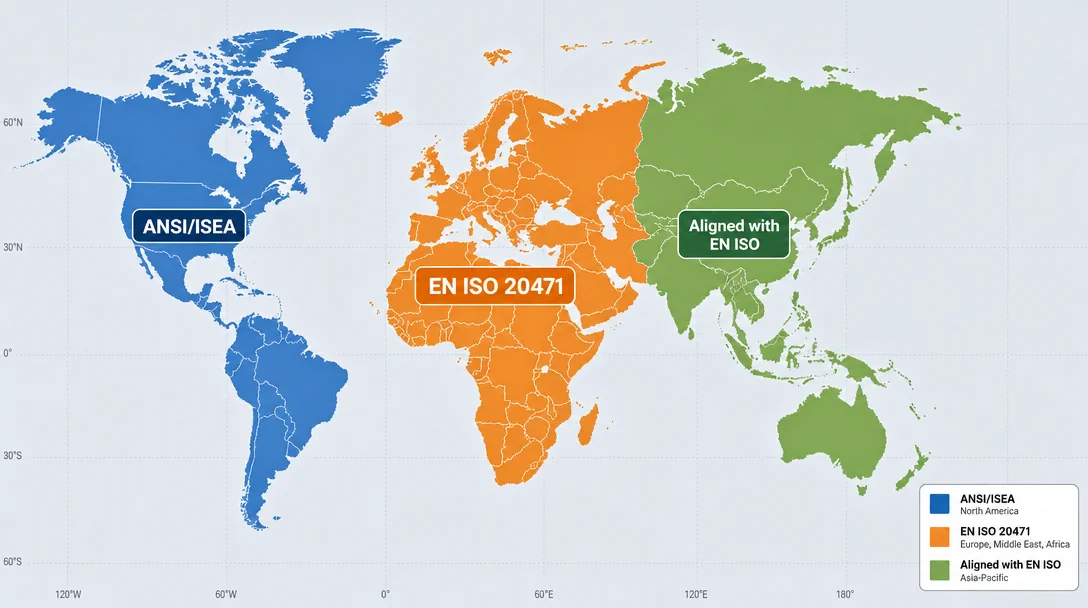
The primary factor in determining which standard applies to your business is the geographic market in which the garments will be used. If your workers or customers are located in the United States, ANSI/ISEA 107 is the applicable standard. If your workers or customers are located in the European Union, EN ISO 20471 is the applicable standard. If your business serves markets in both regions, you need to source garments that meet both standards or maintain separate product lines for each market.
The geographic consideration extends beyond North America and Europe. Many countries in Asia, the Middle East, and Africa adopt EN ISO 20471 as their primary standard for high-visibility safety apparel. Countries such as Australia, New Zealand, the United Arab Emirates, Saudi Arabia, and South Africa all reference EN ISO 20471 or national standards that are closely aligned with it. In contrast, countries in Central and South America may reference ANSI/ISEA 107 or develop national standards that incorporate elements from both frameworks.
For businesses that export to multiple regions, understanding the standard requirements of each target market is essential. A single garment design that meets both ANSI/ISEA 107 and EN ISO 20471 can serve all markets, but this requires careful design and testing to ensure that all requirements are satisfied.
Industry Requirements
Certain industries have specific requirements that influence which standard is applicable. In the United States, the highway construction industry is governed by MUTCD requirements that reference ANSI/ISEA 107 Class 2 or Class 3. Railway workers in the United States are subject to Federal Railroad Administration requirements that reference ANSI standards. In Europe, railway workers must comply with EN ISO 20471 requirements as specified by national railway safety regulations.
The oil and gas industry often has its own internal standards that reference both ANSI/ISEA 107 and EN ISO 20471, depending on the location of operations. International oil and gas companies operating in multiple countries may require dual-compliant garments to simplify procurement and ensure consistent safety performance across all sites. Similarly, multinational construction companies may specify dual compliance to maintain uniform safety standards across projects in different countries.
Emergency services present another consideration. Firefighters, paramedics, and police officers may be subject to different standards depending on their jurisdiction and the nature of their work. In some cases, emergency services garments must meet additional standards beyond ANSI/ISEA 107 or EN ISO 20471, such as flame resistance standards or ballistic protection standards.
Dual Compliance Strategies
For businesses that need garments meeting both standards, there are several strategies to consider. The most straightforward approach is to source garments that have been designed, tested, and certified to meet both ANSI/ISEA 107 and EN ISO 20471 requirements. This approach requires a manufacturer with experience in dual-standard compliance and access to testing facilities that can evaluate garments under both frameworks.
A second approach is to maintain separate product lines for each market. This approach allows for optimization of each product line to the specific requirements of the applicable standard but increases inventory complexity and procurement costs. This strategy may be appropriate for businesses that serve distinct markets with limited overlap.
A third approach is to design garments to the more stringent requirements of both standards and then test and certify under each standard. This approach typically involves using wider retroreflective bands, larger fluorescent areas, and materials that meet the photometric requirements of both standards. The resulting garment may exceed the minimum requirements of one or both standards but provides the flexibility to serve multiple markets with a single product.
Dual Compliance: How to Source Garments Meeting Both Standards
What to Look for in a Manufacturer
Sourcing garments that meet both ANSI/ISEA 107 and EN ISO 20471 requires a manufacturer with specific capabilities. The manufacturer must have access to background fabrics that have been tested and certified under both standards. The manufacturer must source retroreflective materials that meet the photometric and performance requirements of both standards. The manufacturer must design garments that satisfy the placement, width, and area requirements of both standards.
The manufacturer should have an established quality management system that ensures consistent compliance across production runs. ISO 9001 certification is a common indicator of a manufacturer’s commitment to quality management. The manufacturer should also have access to testing facilities that can conduct the required tests under both standards, or should work with independent testing laboratories that provide certification services for both markets.
It is important to verify that the manufacturer has a track record of producing dual-compliant garments. Request references from previous customers, ask for copies of test reports and certificates, and inquire about the manufacturer’s experience with specific garment types and class levels. A manufacturer that has been producing safety garments for international markets since 2010 or earlier is likely to have the experience and infrastructure necessary for dual-compliance production.
HSafetyJackets’ EN ISO 20471 Certification
HSafetyJackets is a Shenzhen-based manufacturer that has been serving global B2B wholesale buyers since 2010. The company is EN ISO 20471 certified and produces a full range of high-visibility safety apparel including safety vests, jackets, coveralls, and accessories. The company’s products are designed and manufactured to meet international standards, and the company serves customers in Europe, North America, Asia-Pacific, the Middle East, and other regions.
The company’s production facility implements quality control procedures at every stage of the manufacturing process, from incoming material inspection to final product testing. Materials are sourced from suppliers that provide test reports demonstrating compliance with applicable standards. Finished garments are tested to verify that they meet the requirements of the applicable standards before shipment.
HSafetyJackets provides customization services including custom colors, logos, sizing, and packaging. The company offers wholesale pricing for bulk orders and provides sample garments for evaluation before placing production orders. For buyers that require dual-compliant garments, the company can design and produce garments that meet both ANSI/ISEA 107 and EN ISO 20471 requirements.
Testing and Quality Control
Testing and quality control are critical components of dual-compliance production. The manufacturer should conduct incoming material testing to verify that background fabrics and retroreflective materials meet the requirements of both standards. This testing should include chromaticity measurement, luminance factor measurement, and retroreflective coefficient measurement using calibrated equipment.
During production, the manufacturer should conduct in-process inspections to verify that garment construction meets design specifications. This includes checking the placement and width of retroreflective bands, the dimensions of fluorescent material areas, the quality of seams and closures, and the overall construction quality of the garment.
Finished garment testing should include all tests specified by both standards. The manufacturer should retain test reports for each production batch and make these reports available to customers upon request. For EN ISO 20471 garments, the manufacturer should maintain a relationship with a notified body that conducts periodic surveillance audits and renews the EU Type Examination Certificate as required.
Regional Compliance Quick Reference
North America
In the United States, ANSI/ISEA 107 is the primary standard for high-visibility safety apparel. OSHA references ANSI/ISEA 107 in several standards, and the MUTCD requires ANSI/ISEA 107 Class 2 or Class 3 for highway workers. In Canada, the CSA Z96 standard applies, which is similar to ANSI/ISEA 107 but has its own class system and requirements. Buyers serving the North American market should verify that garments meet the specific requirements of the applicable standard in each country.
Europe
In the European Union, EN ISO 20471 is the mandatory standard for high-visibility safety clothing under the EU PPE Regulation. Garments must carry the CE mark and be accompanied by a Declaration of Conformity. In the United Kingdom, EN ISO 20471 continues to apply under retained EU law following Brexit, although the UKCA mark may be used as an alternative to the CE mark. Buyers serving the European market should verify that garments have been certified by a recognized notified body and carry the appropriate conformity marking.
Asia-Pacific
In Australia and New Zealand, the AS/NZS 4602.1 standard applies for high-visibility safety garments. This standard is closely aligned with EN ISO 20471 but has some differences in class requirements and testing procedures. In Japan, the JIS T 8127 standard applies, which is based on EN ISO 20471. In China, the GB 20653 standard applies, which is also based on EN ISO 20471. Buyers serving the Asia-Pacific market should verify the specific standard requirements in each country and ensure that garments meet those requirements.
Middle East and Africa
In the Middle East, EN ISO 20471 is widely adopted as the primary standard for high-visibility safety apparel. Countries such as the United Arab Emirates, Saudi Arabia, and Qatar reference EN ISO 20471 in their occupational safety regulations. In Africa, EN ISO 20471 is commonly adopted, although some countries have national standards that incorporate elements from both ANSI/ISEA 107 and EN ISO 20471. Buyers serving these markets should verify the specific requirements of each country and source garments accordingly.
FAQ: ANSI vs EN ISO Hi-Vis Standards
Can a garment be both ANSI and EN ISO compliant?
Yes. Many manufacturers produce dual-compliant garments that meet both ANSI/ISEA 107 and EN ISO 20471 requirements. This typically involves using wider retroreflective bands (50mm to satisfy EN ISO), larger fluorescent areas, and materials tested under both standards. Dual-compliant garments simplify procurement for international businesses.
Which standard is more stringent — ANSI or EN ISO?
Neither is universally stricter. EN ISO 20471 requires wider retroreflective bands (50mm vs 25mm minimum) and mandatory third-party certification. ANSI/ISEA 107 has more detailed class definitions based on use environment and specific traffic speeds. The photometric requirements differ in measurement angles and conditions, making direct comparison difficult.
Does EN ISO 20471 apply in the United States?
No. In the United States, ANSI/ISEA 107 is the applicable standard, referenced by OSHA and MUTCD. However, some US companies serving international markets require dual compliance. EN ISO 20471 garments may be used in the US if they also meet ANSI requirements, but EN ISO compliance alone does not satisfy US regulatory expectations.
How do I convert between square inches and square meters for visibility areas?
1 square meter = 10,000 square centimeters = 1,550 square inches. For practical comparison: ANSI Class 2 (775 sq in) is approximately equivalent to EN ISO Class 2 (0.50 sq m fluorescent + 0.13 sq m retroreflective), though the calculation methods differ between standards.
What happens if my garment fails one standard but passes the other?
The garment can only be sold and labeled as compliant with the standard it passes. A manufacturer cannot claim dual compliance. For international distribution, the garment must be redesigned and retested to meet both standards’ requirements.
결론
The comparison between ANSI/ISEA 107 and EN ISO 20471 reveals that while both standards serve the same fundamental purpose of ensuring worker visibility, they differ in their class definitions, minimum area requirements, material specifications, placement rules, and testing procedures. These differences are not academic. They have real consequences for garment design, material sourcing, testing requirements, and market access.
For businesses that operate in a single market, the choice of standard is determined by the regulatory requirements of that market. For businesses that operate across multiple markets, dual-compliance sourcing is the most efficient approach. A garment designed to meet both ANSI/ISEA 107 and EN ISO 20471 can serve all markets, reduce inventory complexity, and ensure consistent safety performance for workers regardless of location.
When sourcing high-visibility safety apparel for global distribution, buyers should work with manufacturers that have demonstrated experience in dual-standard compliance, access to testing facilities for both standards, and a track record of serving international markets. The manufacturer should provide test reports, certificates of compliance, and documentation that verifies that each production batch meets the applicable requirements.
For dual-compliance sourcing that eliminates the complexity of managing separate product lines, HSafetyJackets designs garments from the ground up to satisfy both ANSI/ISEA 107 and EN ISO 20471 specifications. Our Shenzhen facility has been producing certified hi-vis apparel for international markets since 2010, with full test reports and batch-level documentation available for every order. Whether you need dual-compliant jackets, region-specific garments, or custom sizing for global workforces, our team can help streamline your procurement process. 도매 주문은 HSafetyJackets에 문의하십시오 or request a free dual-compliance specification sheet for your next project.