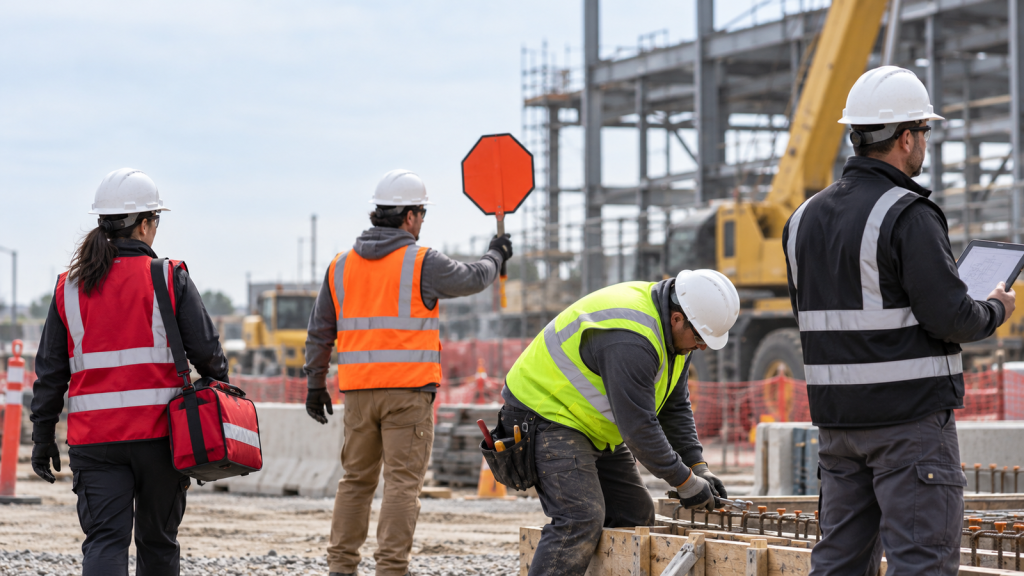
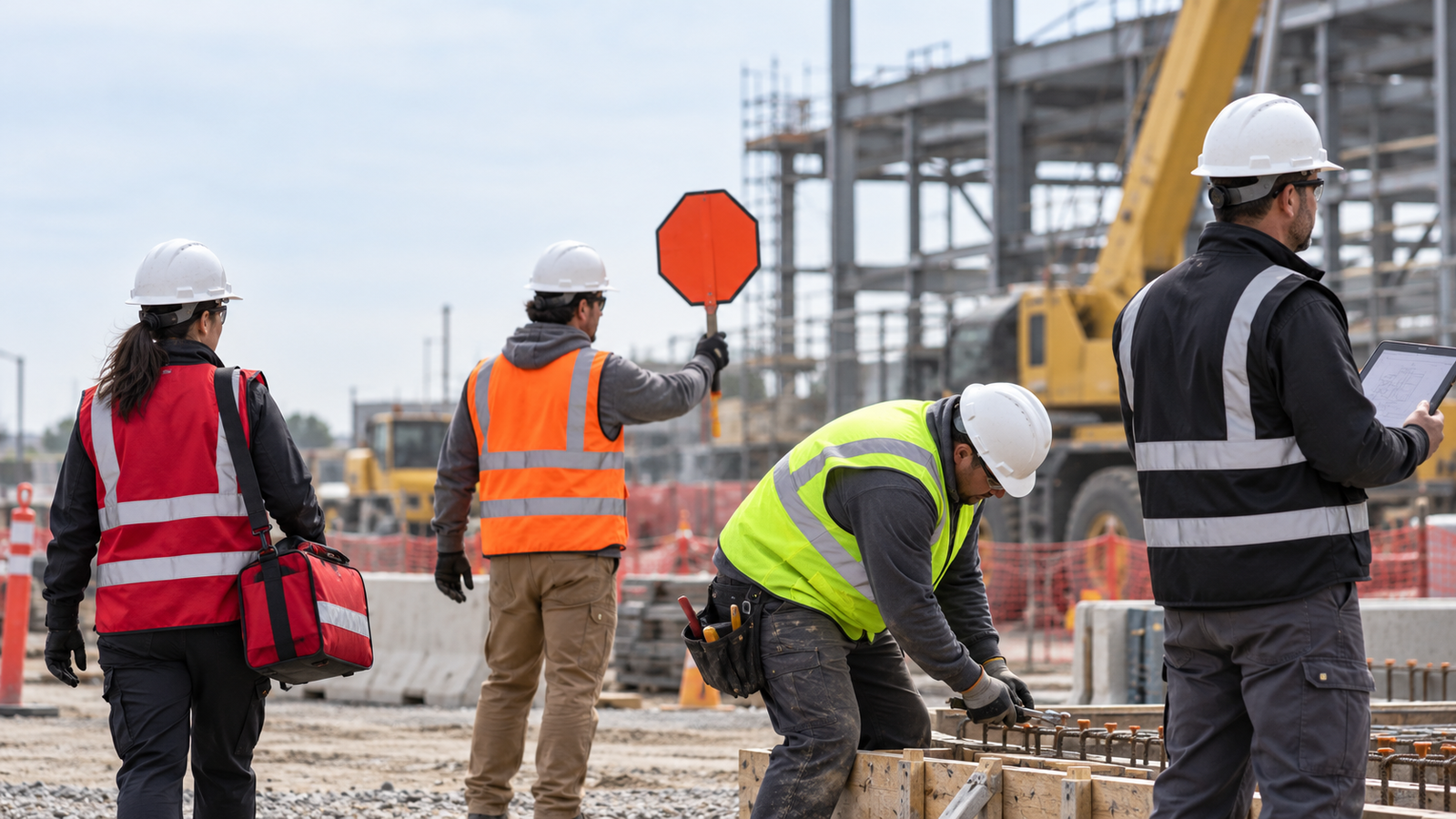
Outfitting several crews at once — operators, contractors, visitors, emergency leads — is where one vest color for everyone stops making sense.
Safety vest color codes are the practice of using vest colors to identify roles, teams and responsibilities on a work site, so workers, supervisors and visitors can recognize who does what at a glance. For buyers, the code is a planning tool: it determines how many vests to order in each color and where visibility performance matters most.
This guide covers the colors commonly used across industries, how to design a scheme for your own crews, and what to clarify with a supplier before a mixed-color bulk order. It is a practical buying guide, not a replacement for your safety rules or applicable standards.
Want to compare shell colors and logo placement first? Request our multi-color swatch card.
Why Safety Vest Colors Follow a Workplace Code
On most large sites, vest color works as a quiet management system. The meaning behind each color comes mainly from industry convention and company-level programs rather than a single universal rule — which is why buyers should define their own code deliberately.
Three practical forces shape it:
- Multi-trade coordination. When builders, welders, drivers and cleaners share one site, color is the fastest signal of trade, employer or role — before anyone reads a badge.
- Visitor and contractor control. Many sites reserve a distinct color for visitors and short-term contractors, so everyone can see at a glance who has completed site induction.
- Emergency identifiability. In an incident, seconds count. If first-aid leads and fire-watch staff wear a color nobody else wears, crews find them without a radio call.
The buying implication: fix the code before you order — a code decided after delivery tends to mean a second order, or colors that mean nothing.
The Main Safety Vest Colors and Their Roles
A small set of colors does most of the work across industries. The table summarizes what each is commonly associated with; the sections below cover when to choose each.
| Color | Commonly Associated Role | Typical Setting | Bulk Buying Notes |
|---|---|---|---|
| Red | Emergency and incident response teams | Incident response, fire watch, first-aid leads | Often ordered in smaller runs for designated roles |
| Orange | Road work and traffic zones | Road work, traffic control, work near vehicles | High-volume color; keep buffer stock for turnover |
| Yellow-green | General high-visibility default | General construction and outdoor crews | The baseline color; see the yellow-green section below |
| Black | Branding-led and low-glare teams | Indoor sites, warehouses, events, branded crews | Pairs well with logo printing; check your site visibility rules |
| Site-defined | Roles your company assigns | Large multi-contractor sites | Run as one multi-color matrix order |
Red Safety Vests: Emergency and Incident Response
Red is the color most commonly associated with emergency and incident-response roles — fire-watch leads, first-aid responders, safety officers — and many safety programs assign red to these positions because it stands apart from everyday hi-vis traffic. Red also carries a strong attention-getting association, which helps when the wearer needs to be found fast. Most red options use the same reflective-tape builds as other colors, so a high visibility vest in red pairs role marking with visibility.
Choose a red safety vest for designated emergency roles and any position your site wants identifiable at a distance — small red runs also take a logo well.
Orange Safety Vests: Road Work and Traffic Zones
Orange is the color road-work and traffic-control crews are most commonly associated with, and many programs treat an orange safety vest as the default for anyone working near moving vehicles. Orange typically runs in high volumes on road projects, so buyers order it with buffer stock — crews turn over and vests disappear faster than planned.
Choose orange for road crews, flaggers and traffic controllers, and confirm the performance class your project or site rules specify before ordering.
Fluorescent Yellow-Green: The High-Visibility Default
Yellow-green is the color most people picture when they hear “hi-vis vest,” and it is commonly treated as the general-purpose default for everyday crews. In a color-coded program it usually plays the baseline — the high-volume color for general workers, while red, orange or black mark specific roles. Choose it for general crews when no special role marking is needed. For fluorescent fabric science, shade selection and yellow-green product comparisons, see our dedicated guide to fluorescent yellow safety vests.
Black Safety Vests: Branding-Friendly and Low-Glare
A black safety vest is a common pick where team identity matters as much as visibility: indoor sites, warehouses, events and branded crews. A black shell gives artwork a clean, low-glare background, which is one reason black-plus-logo combinations are a repeat request in corporate programs.
Choose black for indoor crews, branded teams and supervisors who want a distinct, low-glare look; where your site rules call for specific high-visibility performance, verify any black option against those rules first.
Custom Color Programs: Defining Your Own Site Code
Beyond the common conventions, many companies define their own codes: one color per subcontractor, a distinct visitor color, a reserved color for first-aid leads. None of this needs special products — just a written code, a posted color card, and a supplier who can hold shades consistent across a multi-color order. For multi-contractor sites, a simple written color code is one of the cheapest safety-communication tools available.
How to Choose a Color Scheme for Your Crew
Start From Your Site Rules and Any Applicable Standards
Color comes second. Start with what already governs your sites — your own safety program first, then anything your clients, region or industry expects you to follow. Where those rules specify performance levels, treat color as a separate decision. For the compliance side, see our guide to OSHA safety vest requirements.
Combine Color, Class and Logo in One Decision
Ordering color first and class later leads to re-buying. Decide the three together: which color marks which role, which performance class each role needs (our ANSI Class 2 vs Class 3 comparison explains the difference), and where the logo sits on each shell color so the artwork stays readable across the whole order.
Multi-Color Programs for Large Sites
Large sites get the most from a role matrix: one row per role, with color, class, sizes and quantity per row, ordered as one consolidated batch — consolidating with a single supplier also keeps shades consistent. To scope ranges and sizes, browse wholesale safety vests.
Color program checklist: from audit to rollout
- Audit trades and roles. List every crew, contractor group, visitor type and emergency role, with headcounts.
- Check the rules that apply. Review your safety program and applicable requirements before fixing any color.
- Set a primary color and role colors. Keep the palette to three to five colors.
- Confirm the class per role. Match each group to the performance class it needs (see ANSI Class 2 vs Class 3).
- Fix logo and contrast. Decide placement and artwork variants per shell color.
- Pilot. Run a small batch with one crew and adjust before committing volume.
- Place the full order. Buy the whole matrix in one production run (browse wholesale safety vests).
- Train and publish. Brief new hires in induction and post the color card at every entrance.
Ordering Color-Coded Vests in Bulk
With the code set, ordering becomes a logistics exercise. Most mixed-color programs share the same decision points:
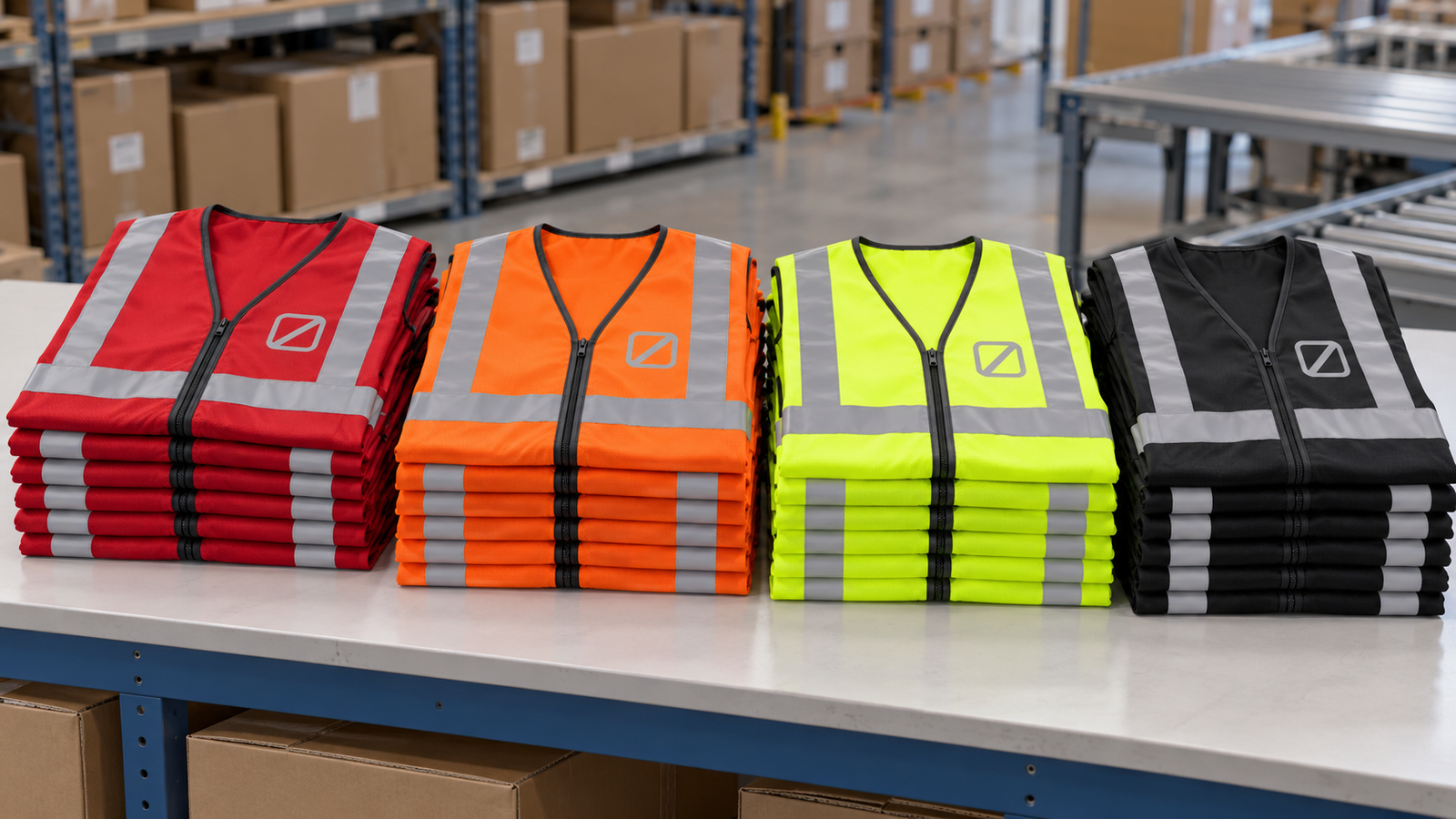
Same logo, different shells. A red safety vest with a logo for emergency leads, plus black vests carrying the same logo for supervisors, is a typical mix. Ask your supplier how they adapt artwork contrast across shell colors rather than assuming one print works everywhere. For decoration methods and artwork preparation, see our guide to custom safety vests with logo.
Per-color quantities and minimums. Suppliers typically quote mixed-color orders per configuration: minimums and lead times vary with the color split, size split and decoration — confirm the exact numbers in writing before you commit.
Packaging and labeling. Ask for vests to be bagged and labeled by color and size, so distribution does not become a sorting exercise.
Shade consistency. Order all colors in one production run where possible — shades vary between dye lots, and a side-by-side color code shows it.
Planning a mixed-color order? Request a quote for your full color matrix.
Preguntas frecuentes
Are black safety vests OSHA approved?
Compliance generally comes down to a vest’s reflective performance and the standards that apply to your site — not the shell color by itself. Rather than searching for an “approved” color, match each vest to the requirements your site rules reference, covered in detail in our OSHA safety vest requirements guide.
What does a red safety vest mean on a job site?
By convention, red is commonly associated with emergency and incident-response roles — fire-watch leads, first-aid responders, safety officers. Some sites extend it to supervisory staff. Red has no single fixed meaning; on your site it means whatever your own color code says, so publish the code and brief crews.
Which vest color is best for road construction crews?
Orange is the color most commonly associated with road work and traffic control, and many programs default to it for crews near moving vehicles. Yellow-green is also widely used for general high-visibility duty. Whichever you choose, confirm the performance class your project specifies before ordering.
Can we use different colors to mark roles on our site?
Yes — this is common practice on multi-trade and multi-contractor sites. Define a short written code, give each role its own color, and post the color card at entrances and inductions, and revisit the code whenever a new trade joins the site. The payoff is faster recognition and fewer mix-ups.
Can we order multiple colors with the same logo design?
Yes. Mixed-color orders with one logo design are a standard request in branded programs. The practical points are logo contrast — artwork may need light and dark variants for different shells — plus per-color quantities and your supplier’s minimums for mixed orders. See our custom safety vests with logo guide for options.
Do vest colors affect compliance?
That depends on the specific requirements that apply to your work, and this article stays on the convention side of that line: we describe what colors commonly mean, not what any regulation concludes. For the standards side, read our OSHA safety vest requirements guide and ANSI Class 2 vs Class 3 comparison.
Conclusion: Order Color-Coded Vests With Confidence
A vest color code is one of the cheapest communication systems a site can run: no hardware, no extra training course — just a short written code, a color card at the gate, and consistent ordering. The matrix you approve once becomes the template for every reorder. Start from your site rules, keep the palette small, decide color, class and logo together, and pilot before the full run.
Ready to build your matrix? Send your role list, color split and quantities, and request a quote for color-coded vests in bulk.